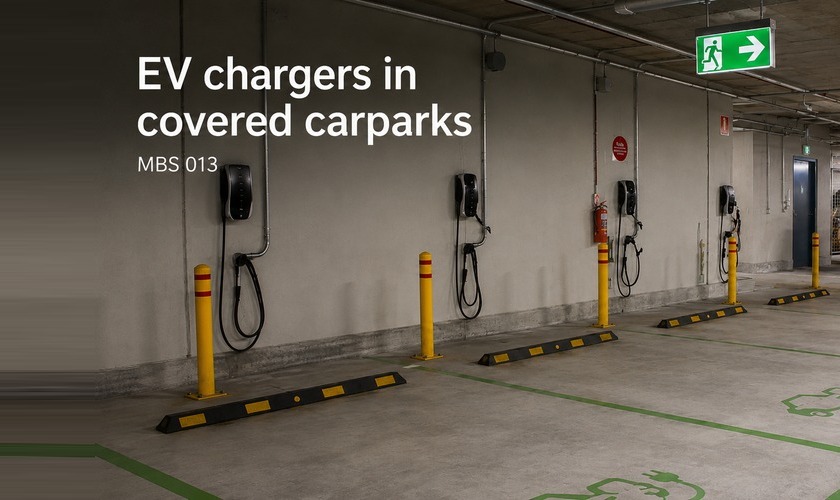
EV chargers in covered carparks: what project teams need to consider
EV chargers are becoming more common in apartment, commercial and mixed-use developments.
In South Australia, MBS 013 – Installation of Electric Vehicle Charging Stations applies to EV charging stations in covered or underground Class 7a carparks, including Class 7a parts of Class 2 to Class 9 buildings.
The standard is not intended to capture every EV charger in every location. An open external carpark presents a different risk profile to a basement or covered carpark. However, where EV charging stations are proposed within covered or underground carparking areas, their location and associated safety measures need to be properly coordinated.
For covered or underground carparks, the design should consider matters including:
- charger location;
- separation from exits, stairs, lifts and fire authority equipment;
- separation from combustible storage;
- spacing between charging stations;
- master isolation switches;
- bollard and impact protection; and
- emergency response signage.
In practice, this means EV charging stations should be clearly shown and coordinated in the approval documentation where they form part of the proposed works.
A charger may appear to be a relatively small item on the drawings, but its location can affect the carpark layout, services coordination, fire authority access, signage, protection measures and compliance pathway.
For designers, developers and builders, the key question is:
Where are the EV chargers proposed, and does that location satisfy MBS 013?
Early coordination is important. EV chargers should not be treated as a late services item if they are part of the proposed development. Identifying the location early allows the architect, electrical consultant, fire services designer, builder and certifier to resolve any issues before construction or completion.
TF Certifiers + Consultants is reviewing EV charger locations and MBS 013 requirements as part of current and upcoming projects.