South Australia’s housing rules have shifted: what the 2027 and 2030 dates mean for residential projects
South Australia’s current building code settings do more than delay NCC 2025. They also preserve key concessions for some alterations and additions to existing homes, while keeping the NCC 2022 modern homes provisions in force for other residential work. For project teams, the real issue is understanding which pathway applies, and when.
South Australia’s current residential compliance position is no longer just a matter of “NCC 2022 versus NCC 2025”. For many projects, the more important question is which transitional pathway applies, and whether a proposal falls within one of the State’s current concessions.
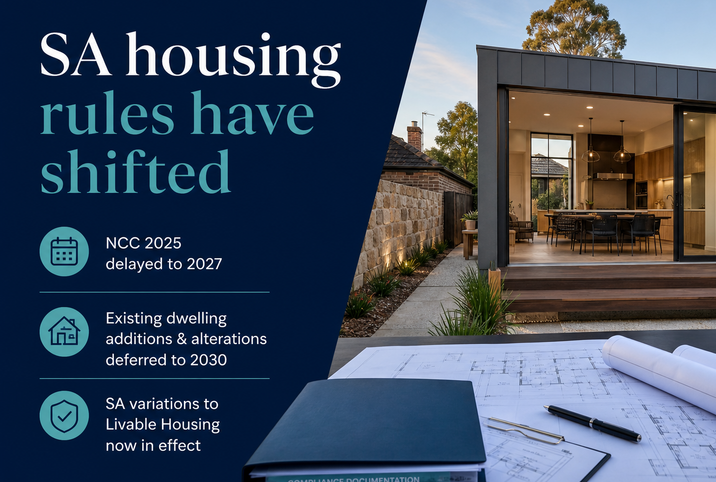
Under the current version of Ministerial Building Standard MBS 007, NCC 2025 will be adopted in South Australia on 1 May 2027. Until then, NCC 2022 remains in force, with NCC 2019 Amendment 1 still preserved for some scenarios through transitional concessions.
For builders, designers, developers and homeowners, that means the compliance answer is now heavily dependent on the type of work, the timing of the application, and whether the project involves a new dwelling, an apartment, or alterations and additions to an existing Class 1 home.
The headline point: NCC 2025 is not the immediate issue in South Australia
A lot of industry commentary has focused on the next edition of the National Construction Code. In South Australia, however, the more immediate issue is the application of the NCC 2022 modern homes provisions, which include energy efficiency, condensation management and livable housing requirements.
Those provisions commenced in South Australia on 1 October 2024, but not without important qualifications. South Australia adopted them with a series of state-specific concessions and modifications, many of which continue to shape how residential work is assessed today.
So while 1 May 2027 is now the critical date for the formal adoption of NCC 2025, that does not mean all current residential work is being assessed under a single uniform standard in the meantime.
Why the 2030 date matters just as much
For many residential clients, the more consequential date is actually 1 May 2030.
Under South Australia’s transitional arrangements, alterations and/or additions to existing Class 1 homes can continue to rely on the relevant NCC 2019 Amendment 1 provisions, provided the development application is lodged before 1 May 2030.
That concession is significant because it means the newer NCC 2022 modern homes provisions do not automatically apply to every extension, addition or alteration simply because the work is residential in nature.
In practice, this affects three areas in particular:
- energy efficiency
- condensation management
- livable housing design
For qualifying alterations and additions to existing Class 1 homes, energy efficiency can still be considered under NCC 2019, condensation management can still be considered under NCC 2019, and the new livable housing design provisions do not apply.
That is a material outcome for projects involving existing homes, especially where site constraints, legacy building conditions or cost sensitivity make the newer requirements more difficult to implement.
Livable housing is already in force, but not without limits
It is also important not to over-simplify the current position by saying livable housing is either “on” or “off”.
In South Australia, Part H8 of NCC 2022 took effect on 1 October 2024 for Class 1a work, but the State’s modifications carve out several important exceptions. Broadly, the new livable housing design provisions do not apply to certain homes, including some built on small or irregular allotments, some workers’ accommodation or tourist accommodation, and some off-site manufactured homes of 70 square metres or less.
Even where those concessions apply, the position is not a complete rollback. The affected homes must still provide wall reinforcement to facilitate the future installation of grab rails.
That distinction matters. It is one of several examples where the South Australian approach is not simply a delay, but a more tailored application of the national provisions to local housing conditions.
The practical compliance question is now more layered
From a certification and design perspective, the real challenge is not just knowing the headline dates. It is understanding how the project should be categorised before assumptions are made about the applicable code pathway.
Key questions now include:
- Is the project a new Class 1 dwelling or an alteration/addition to an existing one?
- When will the development application be lodged?
- Is the site a small or irregular allotment for the purposes of the concession?
- Does the proposal involve off-site manufactured housing?
- Do the livable housing provisions apply in full, in part, or not at all?
These are not merely administrative questions. They can affect layout, sanitary planning, energy strategy, documentation scope and, ultimately, whether a project proceeds smoothly through assessment or ends up requiring redesign.
Our view
The current South Australian framework rewards early classification and early compliance review.
The industry risk at the moment is not that project teams are unaware of NCC change generally. It is that they may rely on an incomplete reading of the transition dates and miss the way MBS 007, the modern homes provisions, and the existing-home concessions interact in practice.
For some projects, the applicable pathway may be more flexible than expected. For others, the newer requirements may already be firmly in play. Either way, the answer turns on the details.
At TF Certifiers + Consultants, our approach is to assess these projects against the actual South Australian adoption position, rather than broad national summaries. Where transitional concessions, livable housing obligations or existing home provisions are in question, early advice can help reduce redesign risk and avoid approval delays later in the process.